American homes are statistically safer than they have been in decades. The FBI’s preliminary 2025 data shows property crime fell an estimated 12.4% in a single year, and the national burglary rate has dropped to its lowest level since federal tracking began. Gallup’s October 2025 crime poll found just 30% of Americans believe crime rose in their local area, down 19 points from the year before.
Americans seem to know it, too. In a new survey of 1,000 U.S. adults by Tri-State Gate, 69% said crime risk in their neighborhood hasn’t changed in two years. Yet only 28% say they feel genuinely safe at home on a typical evening.
That gap between what people know and how they feel is reshaping daily life. Nearly three in four Americans have changed their behavior because of home security anxiety, even as most admit the threat around them hasn’t grown. The story of American home security right now is a story about fear outrunning fact, and about what people do when reassurance is easier to buy than protection.
Key findings
- Only 28% of Americans feel genuinely safe at home on a typical evening, even though 69% say neighborhood crime hasn’t changed
- 72% have changed at least one behavior because of home security fear or anxiety
- The most feared threat, a break-in while the family is home, has happened to just 8% of households in two years
- 33% of security camera owners check their footage multiple times a day, and 81% check daily or whenever an alert fires
- 56% say it would take a break-in or a visible crime pattern before they seriously invest in physical security
- 67% would pay a premium or choose a gated neighborhood over a comparable open one
The safest era on record still can’t buy peace of mind
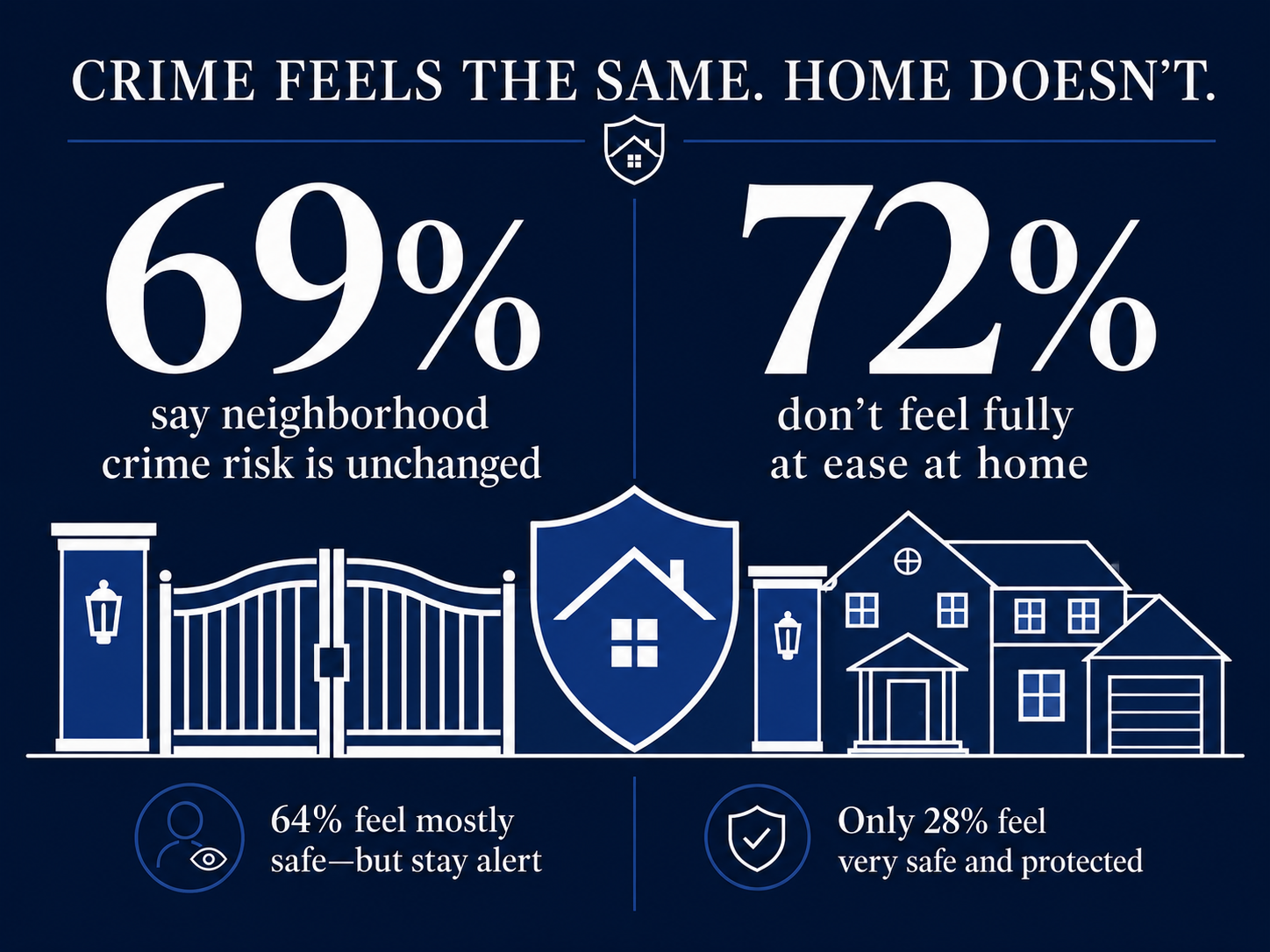
Ask Americans whether their neighborhood has gotten more dangerous, and most give a level-headed answer. 69% said crime risk is about the same as it’s always been. Only 18% said it has gotten worse.
Ask how they feel at home after dark, and the calm evaporates. Just 28% chose “very safe, I feel genuinely protected.” The majority, 64%, picked “mostly safe, but I stay alert.” Combined with the smaller groups reporting unease or fear, that means 72% of Americans do not feel fully at ease inside their own homes.
The finding tracks with national sentiment. Gallup’s October 2025 poll found only 12% of Americans call crime in their local area an extremely or very serious problem, one of the lowest readings in years. The threat has receded. The vigilance stayed.
Low-grade alertness, rather than acute fear, has become the default setting in American households. People aren’t panicking, but they’re never quite off duty.
Americans fear the rarest threat most
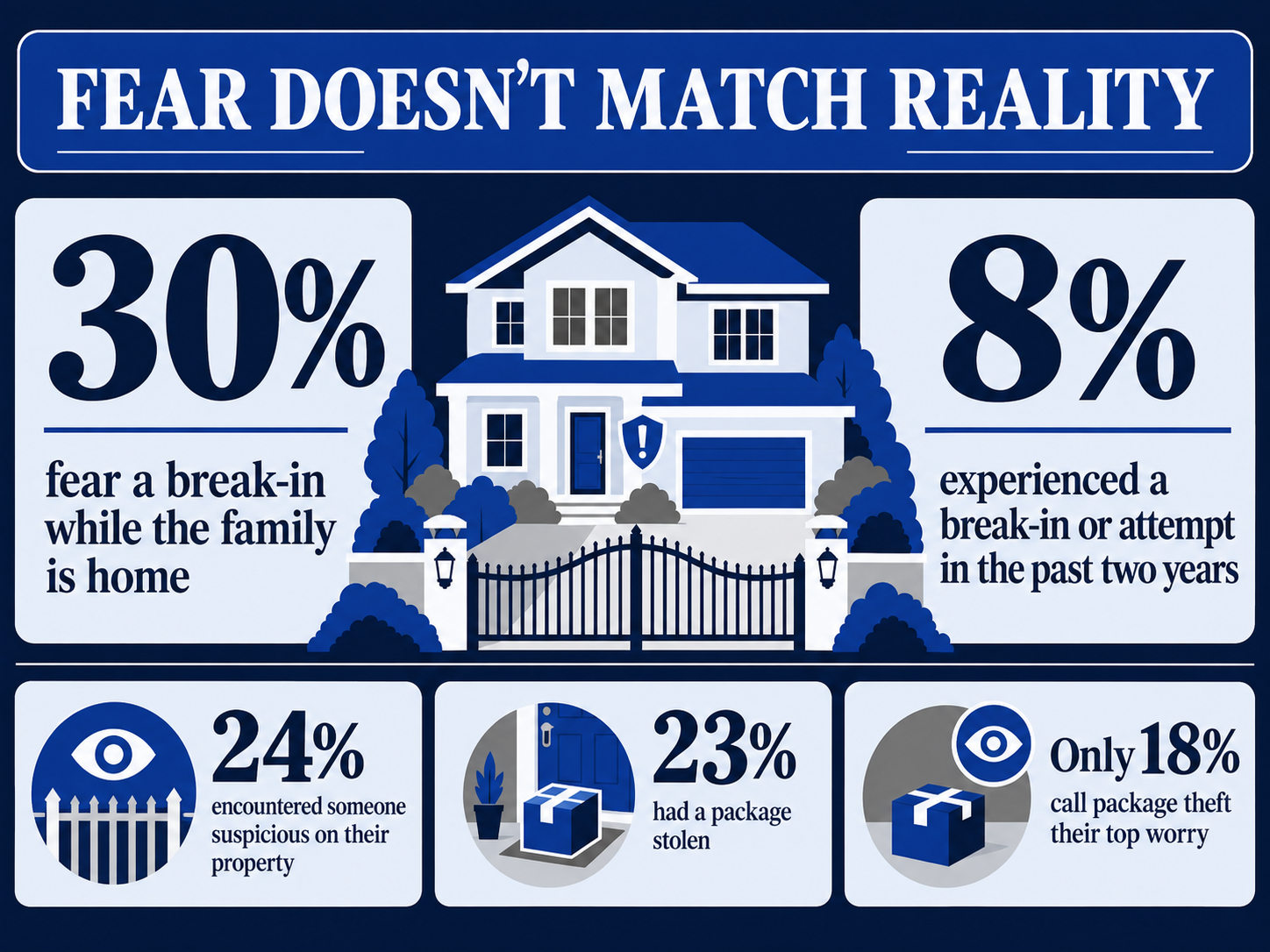
The home security threat that worries Americans the most is a break-in while the family is home (30%). It is the single most selected fear in the survey, and among the least likely events. Just 8% of respondents have experienced a break-in or attempted break-in in the past two years.
The most common incidents barely register as fears. Nearly a quarter of households, 24%, have dealt with someone suspicious lingering on their property, and 23% have had a package stolen. Yet only 18% call package theft their top worry.
Long-standing Bureau of Justice Statistics victimization data found a household member was present in only about a quarter of household burglaries, which makes the occupied-home break-in Americans dread most a statistical outlier.
Some households feel the gap more than others. Men were nearly twice as likely as women to report a stolen package, 33% versus 17%, and 31% of parents with children under 18 have had one taken.
Fear changes routines faster than it changes homes
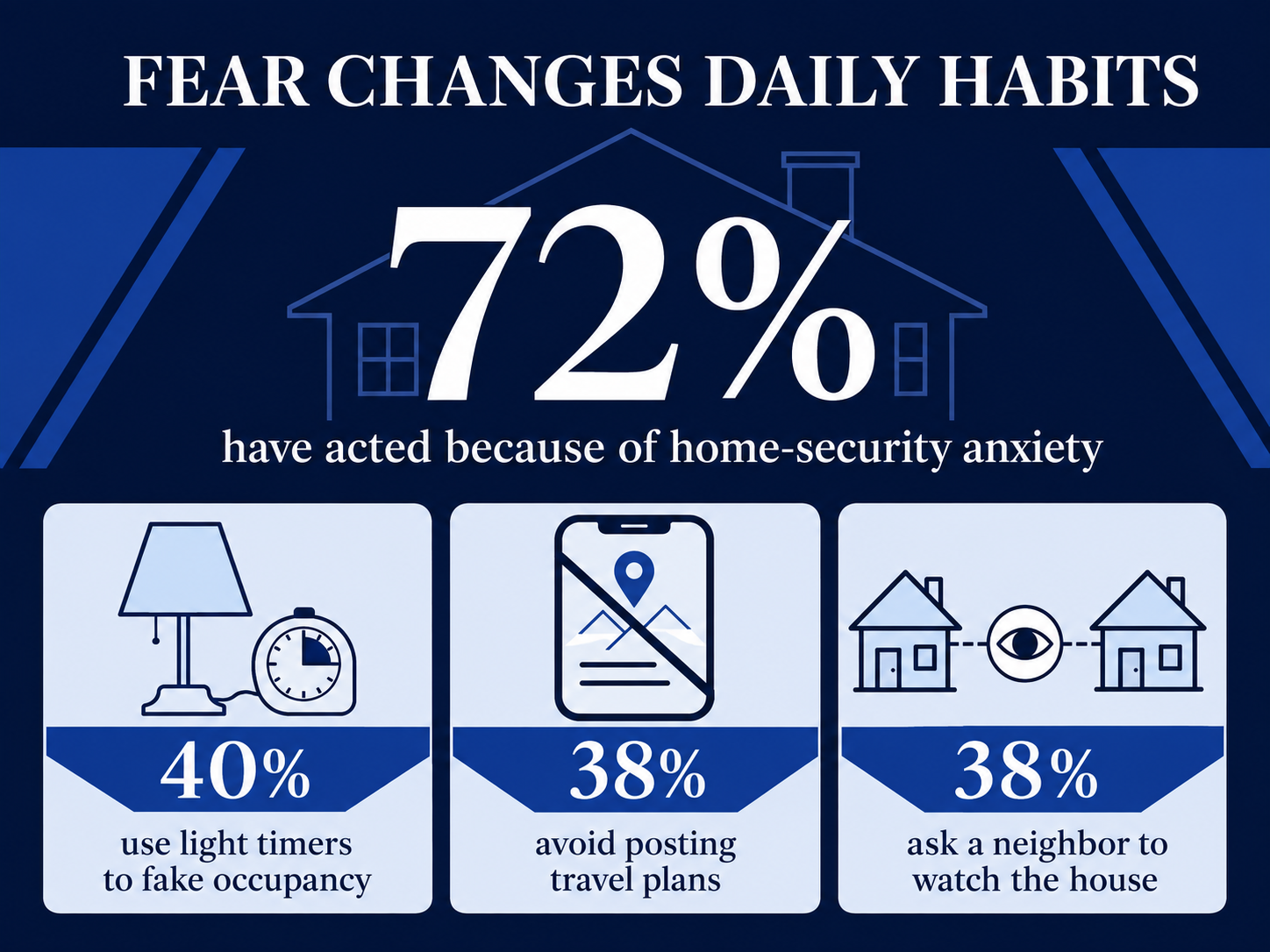
Anxiety is doing real work in American households. It just isn’t structural work. 72% of Americans have taken at least one action specifically because of fear or anxiety about home security.
The most common moves cost little or nothing. 40% leave lights on timers to fake occupancy. 38% avoid posting travel plans on social media. 38% ask a neighbor to watch the house. (Respondents could select more than one.)
Some go further. 15% have stopped having packages delivered to their home address entirely, a figure that climbs to 22% among households earning $100,000 to $249,999. The pattern is consistent: Americans are managing their exposure through routine and concealment rather than through the physical structure of their homes.
Cameras watch the house while owners watch the cameras
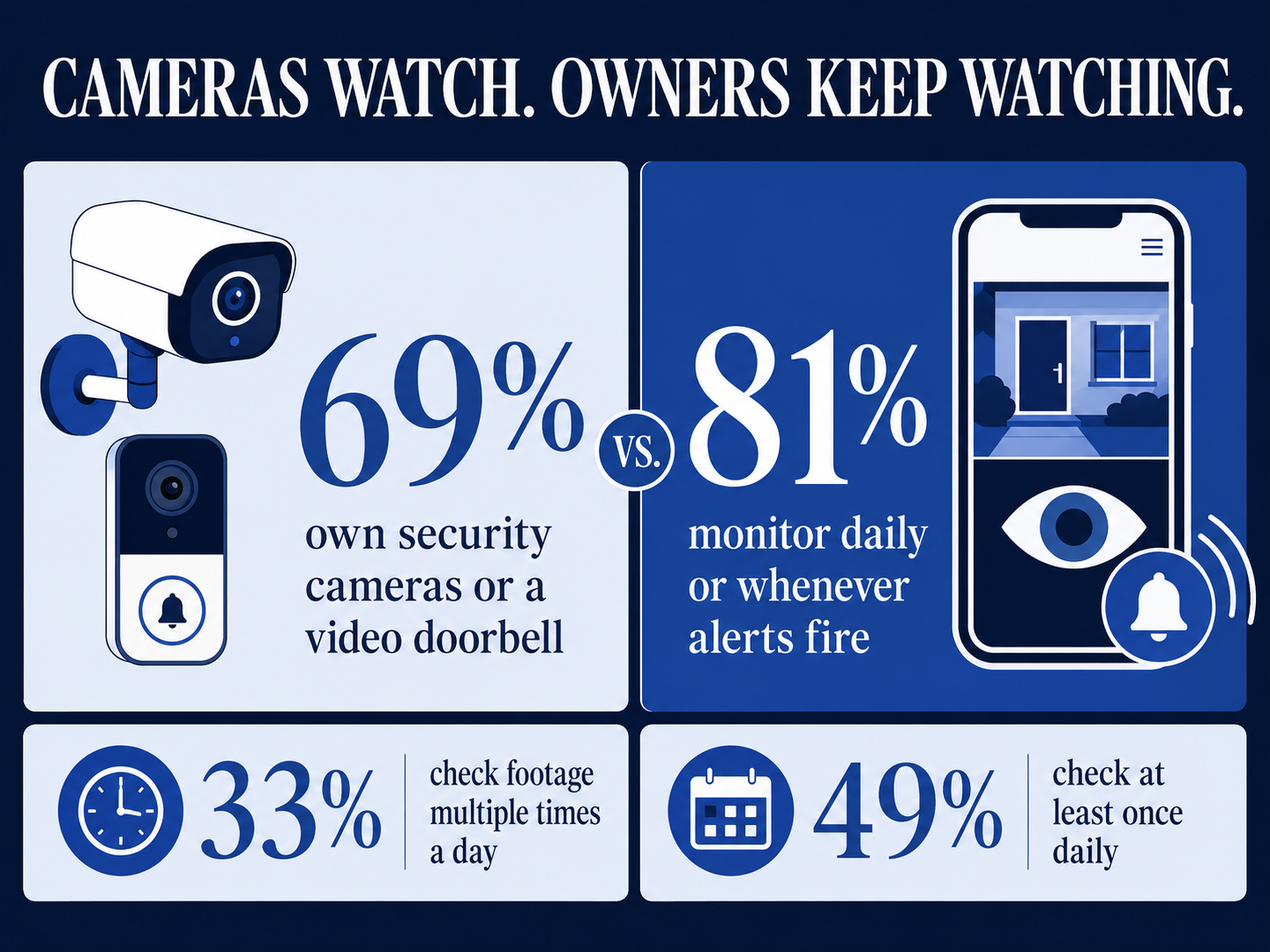
Camera ownership is now the majority position in America. 69% of respondents own security cameras or a video doorbell, a shift mirrored in SafeHome.org’s 2026 market report, which found camera adoption climbed 19 percentage points in two years to reach roughly 74.9 million households.
What the cameras haven’t delivered is rest. Among owners, 33% check their footage multiple times a day, selecting the answer “I can’t help myself.” Nearly half, 49%, check at least once daily. Add those who check whenever an alert fires, and 81% of camera owners are monitoring their homes daily or on demand.
The device sold as peace of mind has become, for many, a habit loop. A third of owners describe their checking as compulsive in their own words. The camera confirms the porch is empty. The alert an hour later asks them to confirm it again.
“Cameras are excellent at telling you what happened, and terrible at making you stop asking,” said Matt Prato, President at Tri-State Gate. “When a third of owners admit they can’t stop checking, that’s a sign the monitoring is managing the homeowner instead of the home. Physical measures don’t send alerts. That’s the point of them.”
The trigger most people are waiting for is a crime
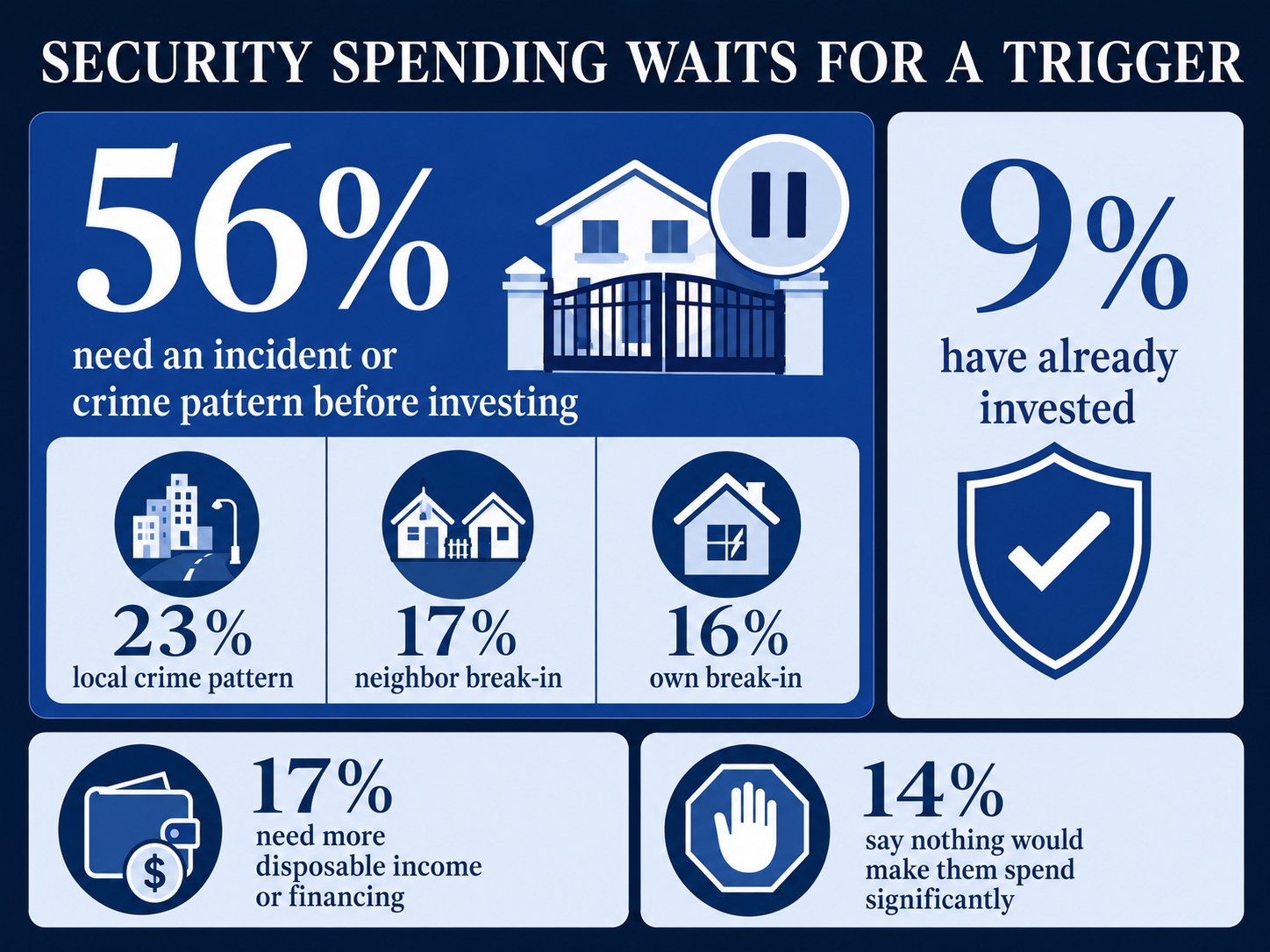
If fear were driving investment, the spending data would show it. Instead, most Americans are waiting. A majority, 56%, say it would take an incident or a visible crime pattern before they seriously invest in physical security: a break-in at their own home (16%), one at a neighbor’s (17%), or a reported pattern of local crime (23%).
Only 9% say they’ve already made that investment. Another 17% cite money, saying they’d act with more disposable income or affordable financing. And 14% say nothing at all would push them to spend significantly.
Prevention purchased after a break-in protects against the previous crime, not the next one. For now, most of the country is running its home security on a wait-and-see basis.
What buyers say a gate is worth
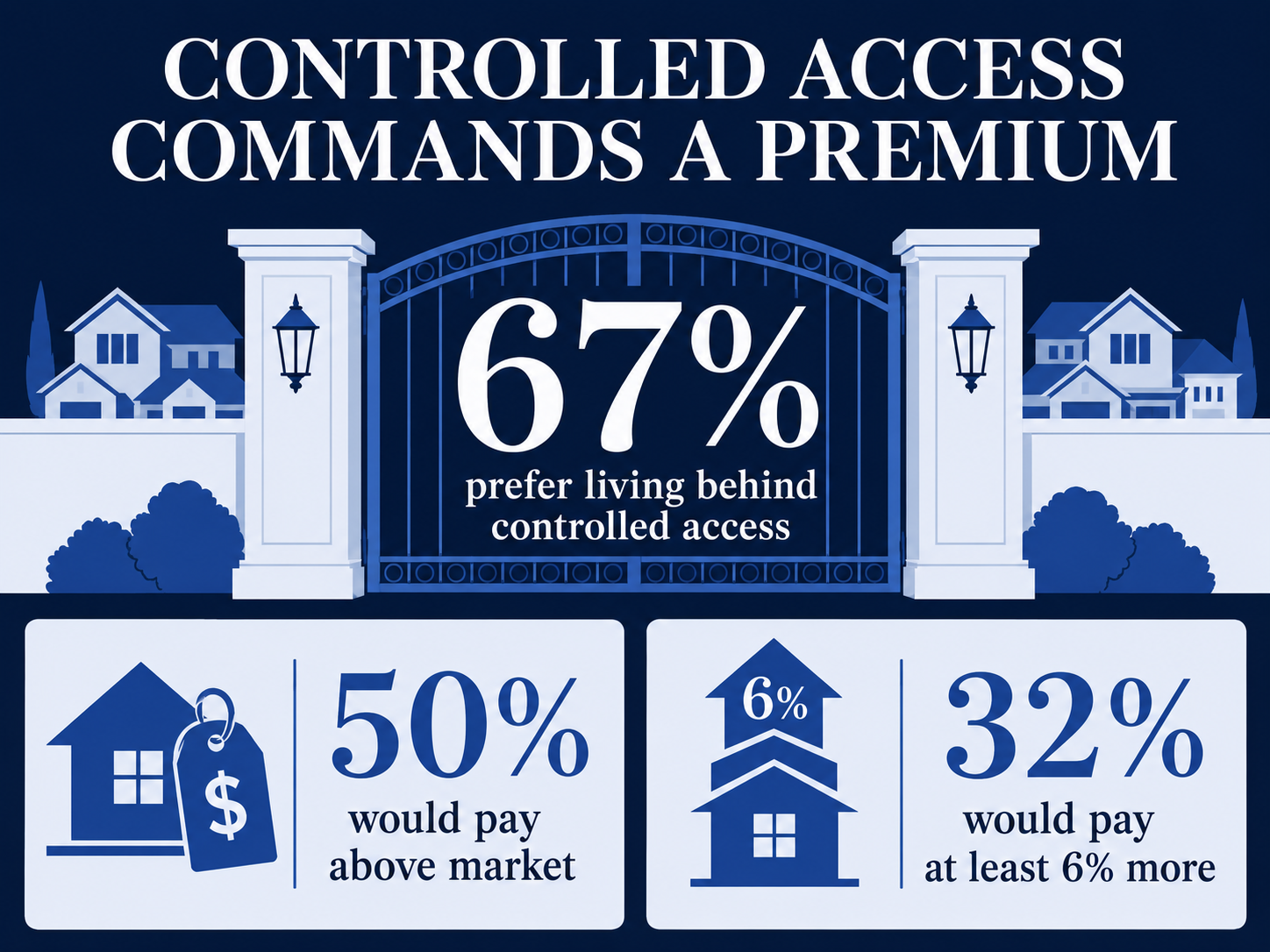
For all the hesitation on spending, Americans put real value on physical barriers when the question turns to where they’d live. 50% would pay above market price for a home in a neighborhood with a gated or controlled entrance. Add those who would choose the gated option at equal prices, and 67% prefer living behind controlled access.
The premium isn’t trivial. Nearly a third of Americans, 32%, would pay at least 6% above the price of a comparable home. Research published by the American Real Estate Society and highlighted by Florida Atlantic University found homes in gated communities command a premium of roughly $30,000 over comparable non-gated homes, suggesting the market has already priced in what buyers say they want.
Parents of young children drive the demand. 44% of parents with children under 18 would pay 6% or more, over twice the 21% rate among parents whose children are grown. Men outpace women on paying any premium, 61% to 43%.
The willingness is there. The purchase, for most households, still isn’t. Two-thirds of Americans say they’d pay to live behind a barrier, while a majority wait for a crime to justify building one.
Summary
The numbers describe a country that has quietly restructured daily life around a threat that keeps shrinking. Crime data says American homes are safer than they’ve been in generations. American behavior says otherwise: lights on timers, vacations kept off social media, doorbell footage checked before breakfast.
None of that vigilance is irrational on its own terms. Watching over what you love is human. But the survey suggests most households have settled into a strange middle ground, anxious enough to change how they live and not quite anxious enough to change what protects them. More than half are waiting for a break-in, their own or a neighbor’s, to justify the investment they already believe in.
Whether that changes may depend less on crime than on habit. Two-thirds of Americans already believe in the barrier; most are simply waiting for a reason the data suggests may never arrive. For now, the gap between what Americans fear and what they do about it remains the most consistent finding in the survey.
Methodology
To understand how Americans approach home security, we surveyed 1,000 adults across the country via Pollfish in August 2026, commissioned by Tri-State Gate. Participants answered questions about their fears, experiences with property crime, security spending, camera habits, and willingness to pay for physical protection. Responses were analyzed by demographic groups to identify trends and disparities.
Fair Use Policy
Users are welcome to utilize the insights and findings from this study for noncommercial purposes, such as academic research, educational presentations, and personal reference. When referencing or citing this article, please ensure proper attribution to maintain the integrity of the research. Direct linking to this article is permissible, and access to the original source of information is encouraged.
For commercial use or publication purposes, including but not limited to media outlets, websites, and promotional materials, please contact the authors for permission and licensing details. We appreciate your respect for intellectual property rights and adherence to ethical citation practices. Thank you for your interest in our research.

Matt Prato is the president of Tri State Gate, and he offers decades of experience in custom gates and access solutions. Having been involved in every aspect of the company from design to fabrication, Matt is a true expert in his craft having worked on countless residential and commercial projects involving custom driveway gates, fences, railings, and other outdoor installations.